
Most people use AI for content every single day. Almost none of them want anyone else to know. Here is the psychology behind that, and what it says about how your work gets judged.
AI has become a normal part of how marketers, social media managers and business owners create content. Yet many of them do not want people to know they use it. The reason rarely has anything to do with the technology. It comes down to how we still judge effort, skill and honesty, largely out of habit rather than anything AI has changed.
Most people I speak to are not pretending AI does not exist. They know it saves time and helps them get more done. What catches them out is how uneasy they feel the moment someone else finds out they have used it. That discomfort is worth examining properly, since it says far more about how we value work than it says about the tool itself.
Why Do People Hide Their Use of AI in Content?
Most people are not worried that using AI is wrong. They are worried about what it will make someone else think of them, whether that is a client doubting their skill, a reader questioning their sincerity, or their own doubt about whether the finished piece still counts as theirs.
A marketer can be entirely comfortable using AI behind the scenes and still feel uneasy about a client knowing. A business owner might use it regularly for social posts, emails or documents, yet still describe the finished piece as something written entirely alone.
Their concern is rarely ‘I should not be using AI’ it is closer to, what will they think of me if they know. That is a different problem.
A social media manager might worry that a client will assume the work they did for them took no skill. A business owner might worry that a thoughtful post will suddenly feel less personal. Someone who writes for a living might wonder whether AI makes their contribution look smaller than it really is. The finished content has not changed. Only the way they imagine it will be judged has.
Why Do We Still Connect Effort With Value?
There is a long-standing assumption that work is worth more when it looks difficult or slow, so when AI speeds up a first draft, the finished piece can feel less valuable even though nothing about its quality has changed.
If someone spends three hours writing an article, the effort is easy to see and easy to respect. If the same person uses AI to help with the first draft and finishes in a fraction of the time, there can be a nagging sense that something has been lost, even when the quality, the thinking and every important decision were the same.
This is one of the reasons people are so sensitive about AI. We are used to valuing the visible part of a job. We see the finished article, the completed campaign or the published post, so it is easy to assume that producing those words is where the value sits.
In practice, much of the skill happens before and after the words appear. Someone still has to know the audience, choose the subject, decide what matters, remove what does not belong, check the facts, adjust the tone and decide whether the piece is good enough to publish. AI can help with the job, it does not make those decisions disappear.
Why Do Marketers Fear Becoming Easier to Replace?
Once a client sees AI produce a reasonable post in seconds, it becomes easy for them to wonder why they are paying someone to do work that suddenly looks automatic, even though that question overlooks almost everything the professional was doing.
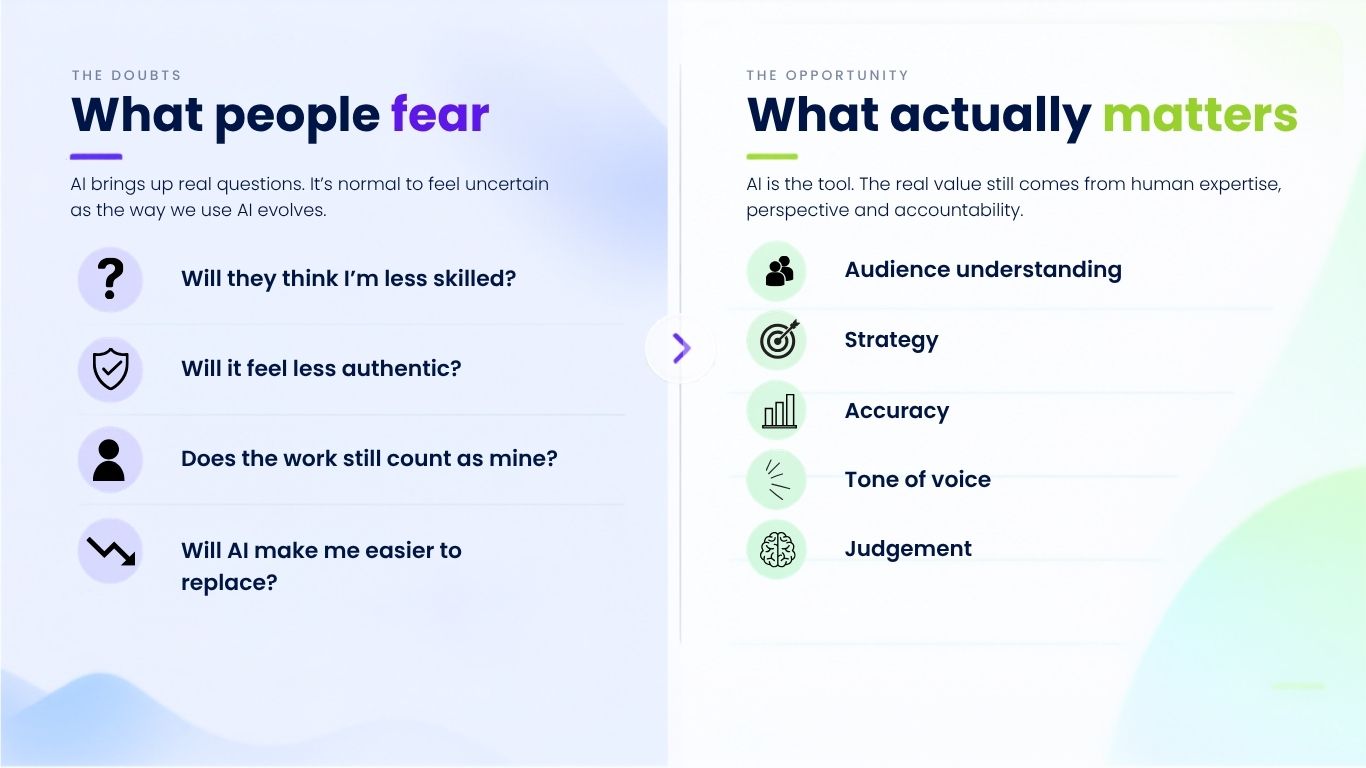
This is probably where the subject becomes most personal for marketers and social media managers. If part of your job involves writing content, watching a tool produce something passable in seconds naturally raises an uncomfortable question in a client's mind.
The problem is that the question focuses entirely on the visible output and misses most of the work around it. A good social media manager is not paid only to type captions. A good marketer is not paid only to produce sentences. They are paid to understand the business, know what the audience cares about, spot the right angle, keep the message consistent and make choices that support a wider plan. The tool can help with the draft in the same way other software has helped people work faster for years. The judgement still belongs to the person using it.
Can Using AI Make You Question Your Own Contribution?
Yes, particularly for anyone who has always thought of themselves as good with words or ideas, since using AI can make it harder to feel that the finished work still fully belongs to them, even when their judgement shaped every part of it.
There is another side to this that has less to do with clients and more to do with how people see themselves. If you have always been the person who is good with words, ideas or content, using AI can feel strange at first. It can make you wonder whether the finished piece still counts as yours, particularly when the tool helped you get there faster than you would have managed alone.
You chose the subject. You knew what needed to be said. You decided which parts were useful and which sounded wrong. You changed the wording, checked the detail and made the final decision about what went out under your name. The tool helped with part of the job. It did not take ownership of your judgement.
For anyone who already worries they should know more about AI, this can add another layer of doubt. Instead of feeling pleased about finding a quicker way to get something off their plate, it can feel like a shortcut that needs hiding.
I don’t think that is a useful way to look at it.
Is There a Difference Between AI-Generated and AI-Assisted Content?
Yes. Content produced by AI with very little human input and published untouched is a different thing entirely from content that is drafted or edited with AI support but still led, checked and decided by a person, and the quality still depends almost entirely on the second part.
This distinction matters more as AI becomes a normal part of content work. A business owner might use AI to turn rough notes into a clearer first draft. A marketer might use it to organise a long piece of content into sections. A social media manager might use it to suggest different ways of expressing an idea they have already developed. Those are all forms of assistance, and the quality still depends on the person making the decisions around the output.
This is why the more useful question is not, was AI used. The better question is, what part did AI play. That tells you far more about the work than a simple yes or no ever could.
Does Using AI Make Content Less Authentic?
Not on its own. Content stays authentic as long as the experience, the view and the final judgement genuinely belong to the person publishing it. Authenticity only becomes a real problem once someone hands over the thinking as well as the words.
People often worry that using AI makes their content less genuine, and that concern is understandable, particularly on social media, where businesses are encouraged to sound personal and show more of the person behind the brand.
Someone can have a clear idea and still struggle to turn it into good writing. Another person may know their subject well and still find it difficult to organise their thoughts into something readers can follow. Using AI to help with that does not make the idea false. If the experience is yours, the view is yours and the final judgement is yours, the fact that a tool helped shape the words does not remove where the thinking came from. The problem starts once someone hands the thinking over as well, which is a very different use of the same technology.
How Are Platforms Already Changing the Disclosure Conversation?
Instagram now applies automatic labels when it detects AI involvement, and during 2026 it added further labels that creators can apply themselves, including a stricter requirement for accounts built around AI-generated personas. LinkedIn has been building similar signals into its own feed, which means disclosure is becoming a live decision rather than a hypothetical one.
This shift matters for anyone weighing up whether to be open about using AI. In May, Instagram introduced an optional label that creators can add to their own profile and posts, simply stating that AI was involved in creating or editing the content. By August, that had hardened into a firm requirement for one specific case: accounts built around an AI-generated person now need to carry the label, or risk reduced reach. None of this stops anyone from using AI. It simply makes the use more visible, and that visibility is exactly where the questions in this article start.
Should You Disclose That You Use AI in Your Content?
There is no single rule that fits every business, every piece of content or every industry, so the decision comes down to how much of the thinking AI was involved in, not to whether it was used at all.
Using AI to tidy a paragraph is very different from publishing content created with almost no human involvement. Writing a genuine business post with some support is also very different from presenting an AI-generated person as if they were real.
For most businesses, the more useful conversation sits behind the label rather than on it. Is a person still reviewing the work. Are the facts being checked. Does the content reflect the real views of the business. Would the person publishing it still be comfortable putting their name to it. Those are worth asking whether AI has been involved or not.
Where Is the Value of Marketing Work Actually Moving?
As AI speeds up production, the valuable part of the job is shifting further towards judgement, meaning the questions worth asking are no longer about how fast content can be produced, but about whether it was worth producing at all.
For years, a great deal of professional value has been tied to production. How quickly can you write the post. How many documents can you produce. How many pieces of content can you get through in a week. AI is changing some of that.
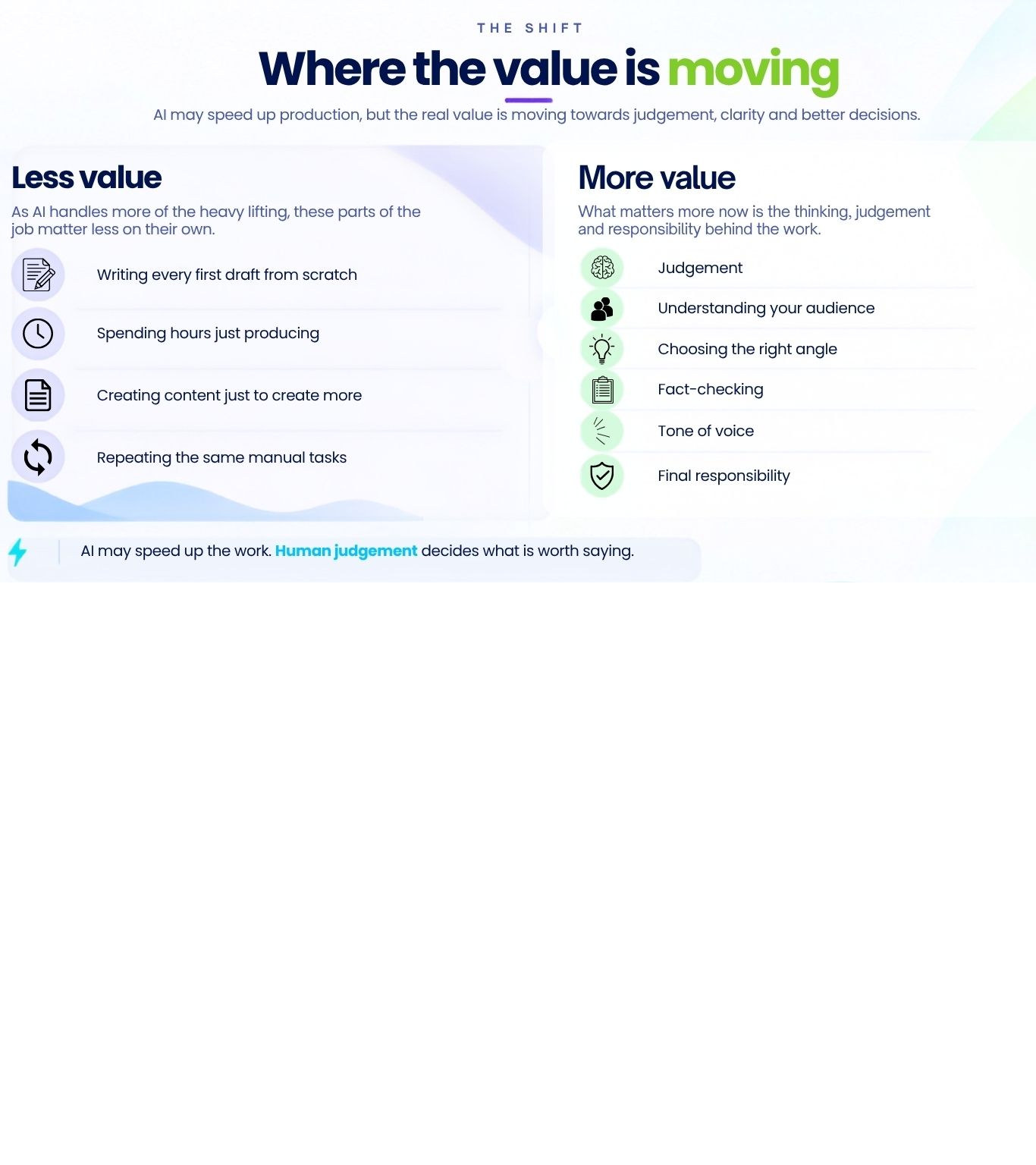
Before anything goes out, it is worth checking whether it is accurate, whether it sounds like the business, and whether the reader will understand it and see what it is meant to achieve. AI can offer twenty headline ideas, but deciding which one belongs on the page is still down to a person, in the same way that knowing whether a draft sounds like you, or checking that a rewrite has kept its meaning intact, are jobs no tool can do for itself.
The skill has not disappeared, it has simply moved. AI is becoming another tool people use to get jobs done. That does not mean every use of it is good, and it does not mean human judgement matters less. If anything, the easier it becomes to produce content, the more important it becomes to know what is worth producing.
I don’t think a marketer needs to prove that every sentence began with a blank screen and was typed by hand. I care far more about whether they understood the business, whether the content says something useful, and whether somebody took responsibility for the finished result. The same applies to a business owner using AI to get ideas out of their head and onto the page.
The human part has not gone anywhere. It has moved into the decisions around the work, and that is the part worth paying attention to.
I would like to know whether this is just me, or whether you see it too. Do people around you use AI quite happily but still prefer that nobody else knows?
Frequently Asked Questions
Should I tell people I use AI to write my content?
There is no single rule, and it depends on how much of the thinking AI was involved in. Being open about the tools you use, while being clear about the editing, judgement and strategy you still provide, tends to build more trust than staying quiet.
Does using AI make content less authentic?
Not on its own. Content stays authentic as long as the experience, the opinion and the final decision belong to the person publishing it. It stops being authentic once the thinking is handed over along with the words.
What is the difference between AI-generated and AI-assisted content?
AI-generated content is produced with very little human input and published largely untouched. AI-assisted content is drafted or edited with AI support, such as adding context like your tone of voice, branding, but still led, checked and decided by a person. The second is the far more common way marketers use these tools.
Will disclosing that I use AI hurt my credibility?
Not because AI was used. Credibility is affected far more by whether the work is accurate, well-judged and genuinely useful to the reader, all of which remain the responsibility of the person publishing it, regardless of which tools helped them get there.
Are platforms now requiring AI content to be labelled?
Some are moving in that direction for specific cases. Instagram has introduced both automatic detection labels and a stricter requirement for accounts built around AI-generated personas. General AI-assisted text, such as a caption drafted with help from a tool, does not currently carry the same requirement, though platform policy in this area is changing quickly.
Your Judgement Is Still the Difference
Using AI to support your content does not make your expertise less valuable.
It gives you more room to focus on the decisions that matter.
Where is content taking longer than it should?
Where could a first draft help you get started?
What still needs your knowledge, voice and final approval?
Start there.
Let AI support the process. Keep the judgement, responsibility and point of view with you.